
Industrial Lubricants for Equipment Performance and Maintenance: Reduce Wear and Downtime
Every hour a production line sits idle costs money, and in most facilities, the root cause traces back to one overlooked variable: lubrication. Choosing the right industrial lubricants for equipment performance and maintenance is one of the simplest ways to cut breakdowns, extend asset life, and protect your maintenance budget – especially in the UAE’s heat, dust, and humidity. At RoyaDunes, we work with facilities across the region to help identify the right formulation for these exact conditions.
Why Industrial Lubricants for Equipment Performance and Maintenance Matter
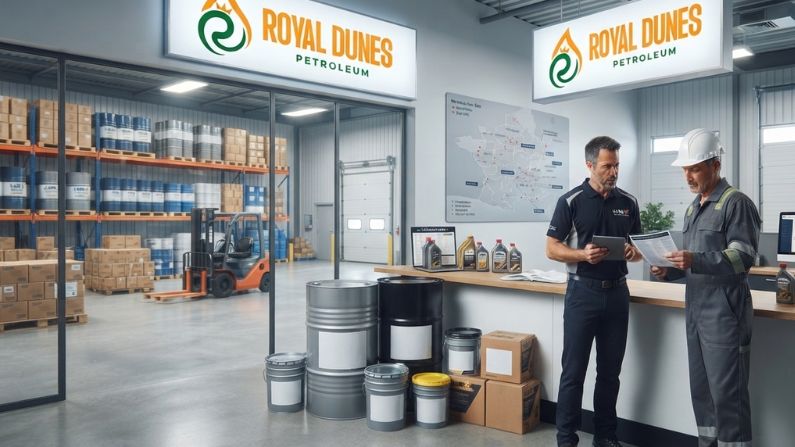
Lubricants do more than reduce friction – they protect equipment on multiple fronts:
- Prevent metal-to-metal contact between moving parts
- Carry heat away from bearings and gears
- Suspend contaminants so dust and debris don’t score components
- Shield against rust and corrosion, especially in humid conditions
The cost of skipping this is real:
- 64% of bearing failures stem from improper lubrication (ABMA)
- Lubrication is ~2% of maintenance budgets, but poor lubrication can push total maintenance costs up 10–20%
- For plants in Jebel Ali, KEZAD, or Dubai Industrial City, that’s tens of thousands of dirhams lost yearly
Types of Lubricants Used for Machine Maintenance
Not every machine needs the same product. The lubricants used for machine maintenance generally fall into a few core categories:
- Industrial oils – Ideal for compressors, turbines, and hydraulic systems where fluid movement and consistent viscosity are critical.
- Greases – Semi-solid formulations that stay in place on chains, motors, gears, and bearings, protecting heavy-load, slow-to-medium-speed components from heat and moisture.
- Pastes and anti-seize compounds – Built for slow-moving, high-load connections such as bolts, fittings, and heavy machinery joints exposed to extreme temperatures.
- Solid lubricants – Graphite and molybdenum disulfide are used where liquids can’t survive, such as high-vacuum or very high-temperature environments.
Within these categories, the base oil matters just as much as the format. Mineral oils remain the most economical choice for standard-duty equipment. At the same time, synthetic and semi-synthetic formulations handle extreme heat, heavy pressure, and extended service intervals far better – a relevant distinction for equipment that runs continuously in Gulf conditions. Food-grade and biodegradable lubricants are also increasingly requested by facilities in food processing, packaging, and environmentally regulated sites across the region.
How UAE Operating Conditions Change Lubricant Selection
Most lubrication guides are written for moderate climates, but equipment running in the UAE faces a different set of stresses:
- Sustained high ambient heat accelerates oxidation and thins out lubricants faster than manufacturer charts anticipate, particularly for outdoor-installed compressors, cranes, and construction equipment.
- Airborne sand and fine dust work their way into open gearing, chains, and bearing housings, turning ordinary grease into an abrasive paste if the formulation lacks strong dirt-suspension and sealing properties.
- Coastal humidity, especially around Dubai, Abu Dhabi, and Sharjah’s port and marine zones, increases the risk of water washout and corrosion, calling for lubricants with strengthened rust inhibitors and water resistance.
- Continuous multi-shift operation in sectors like oil and gas, ports, and manufacturing means shorter theoretical re-lubrication intervals than equipment running standard single shifts elsewhere.
This is why manufacturer manuals are a starting point, not the final word — the “ideal condition” assumptions they’re written under rarely match a Gulf-based production floor or an outdoor construction site in August.
Key Selection Factors for Industrial Lubricants
When evaluating industrial lubricants for a specific application, a maintenance manager should weigh:
Operating temperature range
Determines base oil type and whether oxidation resistance is a priority.
Speed and load
High-speed, light-load equipment needs lower-viscosity oils that flow easily; slow-moving, heavy-load machinery needs thicker, extreme-pressure (EP) formulations.
Contaminant exposure
Dust, moisture, and chemical exposure call for stronger sealing and suspension properties.
NLGI grade (for greases)
Softer grades suit centralized automatic systems; firmer grades stay put on exposed, heavy-load components.
OEM compatibility
Always check equipment manuals, but adjust for real-world site conditions rather than assuming lab-tested defaults apply.
ISO and industry compliance
Especially relevant for food processing, marine, and export-linked manufacturing operations that require certified formulations.
Best Practices for Industrial Equipment Maintenance
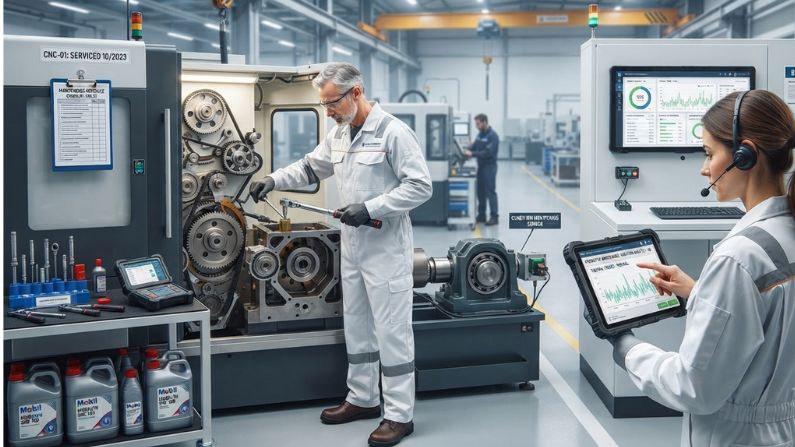
Selecting the right product is only half the equation – consistent application is what actually protects equipment. A solid lubrication program should include:
- A documented lubrication schedule based on operating hours, not just calendar dates, since continuous-shift equipment wears differently than intermittently used machines.
- Correct application quantity and method, since both over-greasing (which raises operating temperature and can damage seals) and under-greasing (which accelerates wear) cause failures.
- Routine oil and grease sampling to catch contamination, additive depletion, or viscosity breakdown before it causes a shutdown.
- Proper storage – sealed, upright, shaded containers – since heat-exposed or improperly stored lubricant can degrade before it’s even applied.
- Trained personnel who understand which product goes where, since mixing incompatible lubricants can damage seals or reduce performance.
- Maintenance records that track lubricant type, application dates, and machine condition, building a history that flags recurring problems early.
Facilities moving toward predictive and condition-based maintenance are also using oil analysis data to fine-tune re-lubrication intervals rather than relying on fixed schedules – thereby reducing both waste and unplanned downtime.
The Real Cost of Getting It Wrong
Poor lubrication rarely causes a dramatic, single-point failure – it shows up as a slow creep:
- Cycle times lengthen as friction increases
- Energy consumption rises as equipment works harder
- Bearings run hotter, accelerating wear
- Metal particles circulate through the system, causing further damage
By the time a breakdown occurs, the damage has usually been building for weeks. Facilities that treat lubrication as a strategic input – not a routine top-up task – see:
- Fewer emergency repairs
- Longer intervals between overhauls
- Lower total cost of ownership on critical assets
Partner with Royal Dunes for Industrial Lubricants for Equipment Performance and Maintenance
Choosing the right industrial lubricants for equipment performance and maintenance isn’t a one-time decision – it’s an ongoing partnership:
- Formulations matched to your real operating conditions, not just manufacturer defaults
- Local technical support across the UAE
- Reliable supply you can count on
If your equipment is running harder than it should, our team can help you find the right lubricant for your operating conditions. Contact Royal Dunes today for a consultation.
Conclusion
Reliable equipment performance starts with a lubrication strategy built for the conditions machinery actually operates in, not the conditions a manual assumes. From selecting the correct oil, grease, or paste to accounting for UAE-specific heat, dust, and humidity, every decision in your lubrication program directly affects wear rates, energy use, and downtime. A proactive approach – the right product, applied correctly, on a data-informed schedule – remains one of the most cost-effective ways to protect industrial assets and keep operations running without interruption.
Frequently Asked Questions
1. How often should industrial equipment be re-lubricated?
It depends on operating hours, load, and environmental exposure rather than a fixed calendar interval. Equipment running continuously in high heat or dusty conditions typically needs more frequent attention than manufacturer defaults suggest.
2. What's the difference between industrial oils and greases?
Oils flow and are best for high-speed, fluid-movement applications like compressors and hydraulics, while greases stay in place and are better suited to heavy-load, slower-moving components like chains, gears, and bearings.
3. Can I use the same lubricant for all my machines?
No. Different equipment types have different load, speed, and temperature requirements, and using a mismatched lubricant can accelerate wear or damage seals rather than protect the machine.
4. Why do lubricants degrade faster in the UAE compared to other regions?
Sustained high temperatures, airborne dust, and coastal humidity all accelerate oxidation, contamination, and water washout, making climate-appropriate formulations and shorter monitoring intervals especially important here.
5. How does improper storage affect industrial lubricants?
Leaving containers unsealed or exposed to extreme heat can cause moisture contamination, additive degradation, and viscosity breakdown before the lubricant is even used.